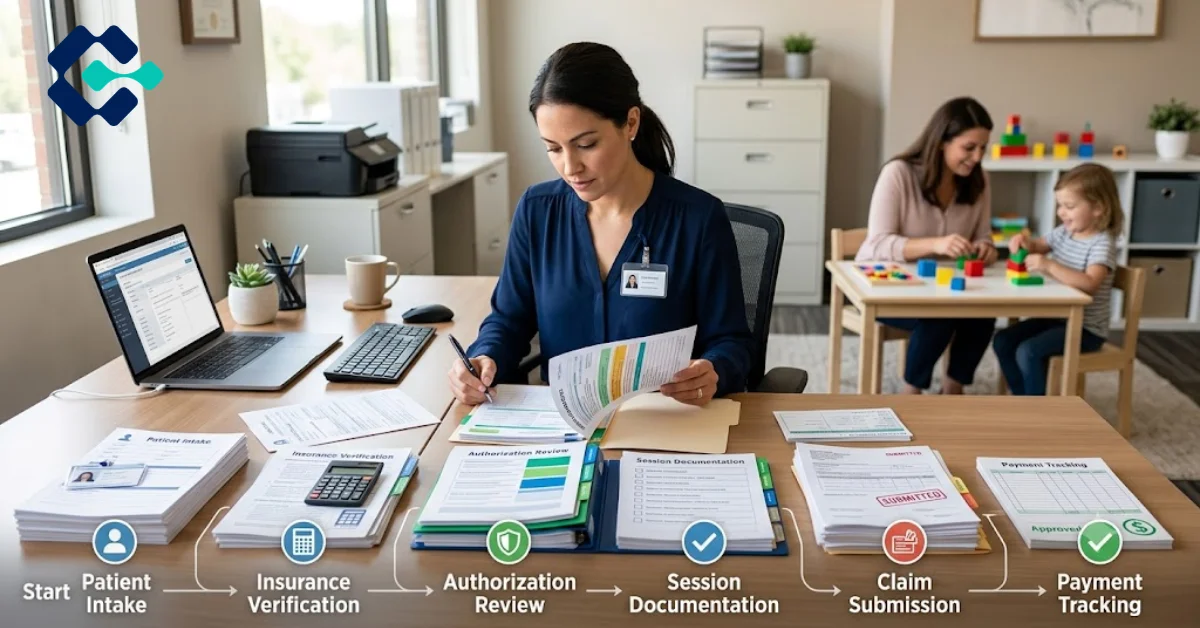
ABA billing isn’t complicated because the rules are hard to understand. It’s complicated because there are so many of them, they change often, and one small mistake early in the process can silently kill a claim several steps later. That’s the real frustration most providers run into.
This guide walks you through the entire revenue cycle for ABA therapy, from verifying insurance on day one to appealing a denial thirty days later. Whether you’re running a solo BCBA practice or managing billing across a multi-site clinic, the same process applies. The details just scale differently.
Why ABA Billing Is Different From Standard Medical Billing
Most medical billing works in fairly predictable cycles. A patient comes in, a service is rendered, and a code gets submitted. ABA therapy doesn’t work that way.
Sessions are long, sometimes three, four, or five hours. Multiple providers often work with the same patient. BCBAs supervise RBTs, and both bill differently for the same session. There are supervision ratios to track, authorization limits that reset on dates that don’t always align with the calendar year, and insurance companies that handle ABA coverage inconsistently, even within the same payer.
That’s before you get to CPT codes. ABA has its own set, introduced in 2019, and not every payer has adopted it uniformly. Some still use outdated codes. Some require specific modifiers. Some require both.
If your billing staff comes from a general medical background, they’ll hit a wall quickly. Getting ABA billing services right means knowing the specific rules that apply to this specialty, not just borrowing general medical billing habits and hoping they hold up.
Step One: Insurance Verification And What Most Clinics Miss
Before a single session happens, you need to know exactly what the patient’s plan covers, not roughly, but precisely.
Most practices check the basics: Is ABA covered? What’s the copay? Is the deductible met? That’s not enough.
Here’s what a thorough verification actually looks like:
Coverage specifics: Does the plan cover both assessment and treatment? Some plans cover one but not the other. Ask about benefit limits, including annual visit caps or dollar maximums specifically for behavioral health or ABA.
Provider network status: Is your practice in-network with this specific plan? If you’re credentialed with the parent company but not the subsidiary, you may not be. Blue Cross plans, for example, vary significantly by region.
Coordination of benefits: If the patient has two insurance plans, you need to know which is primary and how the secondary handles ABA claims. This is a frequent source of delayed payments.
Prior authorization requirements: Some plans require authorization before the initial assessment. Some only require it before treatment. Some require separate authorizations for different CPT codes. Get this wrong, and you’ll be doing the session without reimbursement.
Timely filing limits: These vary by payer. Some give you 90 days. Some give you 365. Know the deadline before you start.
Document everything from the verification call: the date, time, representative’s name, and reference number. If a claim gets denied later and you can prove what you were told during verification, you have a strong basis for appeal.
Step Two: Prior Authorization for ABA Therapy
Prior authorization is where a lot of practices lose money they don’t even realize they’re losing.
The authorization process typically requires a clinical assessment report, a BCBA-written evaluation documenting the diagnosis, treatment necessity, and proposed hours. Most payers require that the treating BCBA hold a current license and that the treatment plan aligns with the requested service hours.
Requesting too few hours. If you get authorized for 10 hours per week and the child needs 20, you’ll have to pursue reauthorization much sooner. Some payers treat this as a new request. Others allow amendments. Know the difference before you submit.
Authorization gaps. If your current authorization expires on the 31st and the new one doesn’t get approved until the 15th of the following month, you have a two-week gap. Services rendered during that gap usually won’t be covered retroactively. Track expiration dates aggressively and set reminders 30 days in advance.
Payer-specific clinical criteria. Most major commercial payers use Magellan, Optum, or their own internal guidelines for ABA medical necessity. Know which criteria set your payer uses and write your assessment reports to address those criteria specifically, not just generally.
Reauthorization timing. Don’t wait until the last week of an authorization period to submit a reauthorization request. Some payers take two to three weeks to process, sometimes longer. If you’re consistently getting caught in gaps, move your reauthorization submissions up by 45 days.
Step Three: Patient Intake and Clinical Documentation
This step feels administrative. It is, in fact, clinical risk management.
Accurate demographic information is the foundation of a clean claim: the patient’s name exactly as it appears on the insurance card, date of birth, member ID, and group number. One transposed digit in a member ID will result in a rejection. Not a denial, a rejection. The claim won’t even be processed.
Beyond demographics, your intake documentation must support the medical necessity of treatment. That means:
- A current DSM-5 diagnosis from a licensed provider
- A functional behavior assessment or similar evaluation conducted by a BCBA
- A written treatment plan with specific goals tied to the diagnosis
- Parent or guardian consent forms
Some payers require these documents during authorization, others audit them later, but they must always be complete and available.
Clinical documentation also determines CPT codes. 97151 is for BCBA assessment, while 97153 is for technician-delivered treatment. The code depends on who delivered the service and the context.
ABA CPT Codes: A Practical Reference
The ABA-specific CPT codes have been in place since 2019, and most payers have transitioned to them. Here’s a working reference:
97151: Behavior identification assessment by a BCBA. The evaluation code is billed in 15-minute increments.
97152: Behavior identification supporting assessment. Used when a technician assists the BCBA during the assessment. Also billed in 15-minute units.
97153: Adaptive behavior treatment by a technician, direct one-on-one. The most commonly billed code for RBT-delivered sessions. Billed per 15-minute unit.
97154: Group adaptive behavior treatment by a technician. Requires at least two patients in the same session.
97155: Adaptive behavior treatment with protocol modification. The BCBA is directly involved in modifying or adjusting protocols during the session.
97156: Family adaptive behavior treatment guidance. Covers caregiver training conducted by the BCBA. An important code for parent-mediated programs.
97157: Multiple-family group adaptive behavior treatment guidance. Less commonly used, but applicable for group caregiver training.
97158: Group adaptive behavior treatment with protocol modification. BCBA-directed, multi-patient group format.
Some payers require modifiers like U1–U8 for provider type, HO for BCBA, and GT for telehealth ABA sessions; always verify per payer.
Some Medicaid programs still use H-codes (like H0031, H2019), so don’t assume all payers use CPT codes.
Step Four: Clean Claim Submission
A clean claim contains all the information a payer needs to process it without asking follow-up questions. That sounds simple. In practice, it rarely is.
The most common reasons ABA claims come back as rejections or denials include:
- Incorrect or missing NPI (billing vs. rendering provider)
- Authorization number not included on the claim
- Service date outside the authorization period
- Units billed exceeding authorized units
- Modifier missing or incorrect
- The diagnosis code does not match the authorized diagnosis
- Place of service code incorrect (home vs. clinic vs. school)
Each denial adds time, resubmission can delay payment by 30–60 days, and across many patients, this hurts cash flow.
Run every claim through a scrubber before submission and use payer-specific rules since requirements vary by insurer.
Use electronic submissions instead of paper claims to reduce delays and errors.
Step Five: Payment Posting and Reconciliation
EOB/ERA shows what was billed, paid, adjusted, and denied. Reading it correctly is key to accurate billing.
Post payments by matching them to the right patient and date; bulk posting causes errors in A/R.
Contractual adjustments are written off per payer contract and can’t be billed to patients.
Patient responsibility (copay, deductible, coinsurance) should be collected from patients upfront.
Underpayments should be checked against your fee schedule and disputed if incorrect.
Denial Management: The Part Most Practices Get Wrong
Denials are a normal part of ABA billing. The practices that perform well financially aren’t the ones that never get denials; they’re the ones that work denials quickly and effectively.
Every denial has a reason code. Learn them. The most common ones in ABA billing:
CO-4: Means code, and the modifier doesn’t match. Update the modifier and resubmit the claim for processing.
CO-11: There is a mismatch between the diagnosis and the procedure code. The diagnosis code on the claim doesn’t support the service billed.
CO-15: Means the authorization number is missing or invalid. Add or correct the auth number and resubmit the claim.
CO-50: Not medically necessary. The payer’s clinical reviewers didn’t agree with the treatment justification.
CO-97: The benefit for this service is included in the payment for another service. Often seen when billing overlapping codes in the same session.
Different denial codes need different actions. CO-4 is a quick fix, correct, and resubmit. CO-50 needs a formal appeal with clinical documents. This denial typically means you need to confirm the bundling rules with the insurance payer.
Review denials within 5 days and send appeals within 30 days to avoid missing deadlines.
If CO-15 keeps repeating from one payer, it’s a process issue, not a claim error.
Revenue Cycle Reporting: What to Actually Measure
Most practices track revenue. Fewer track the right things.
Here are the metrics that actually tell you how your ABA billing is performing:
Clean claim rate: The percentage of claims that pass through without rejection or denial on the first submission. A healthy rate is above 95%. Under 90% signals a systemic problem somewhere in your front-end process.
Days in accounts receivable (A/R): How long it takes, on average, to collect payment after a service is rendered. For ABA practices, under 40 days is strong. Over 60 days suggests payment posting delays, denial backlogs, or both.
Denial rate: This refers to the percentage of submitted insurance claims that are denied. Track this both overall and by payer. A high denial rate from one payer often points to a credentialing, authorization, or coding issue specific to that relationship.
Collection rate: What percentage of the allowed amounts you actually collect, including both payer payments and patient responsibility. A rate below 90% suggests billing gaps or patient collections issues.
A/R aging buckets: Break your outstanding claims into 0–30, 31–60, 61–90, and 90+ day buckets. Claims in the 90+ bucket are at significant risk. Claims past 120 days are often uncollectible unless you act immediately.
Review these numbers monthly. High-performing practices review them weekly for their largest payers.
Credentialing and Its Impact on Cash Flow
Credentialing is a key part of ABA billing.
If a provider isn’t credentialed, claims won’t be paid. It can take 60–180 days, so it should be started early, ideally before seeing patients.
Credentialing (approval) is different from contracting (agreed rates). Both are required to get paid in-network.
Practices should track all providers’ credentialing dates, payer status, and revalidation deadlines to avoid losing billing eligibility.
Telehealth ABA Billing: What’s Changed and What Hasn’t
Telehealth ABA became widely used after 2020, and in 2026, most commercial payers still cover it, but rules vary.
BCBA services like assessments, treatment updates, and caregiver training are most commonly covered. Direct RBT telehealth is less commonly approved.
Correct billing depends on details like place of service codes (POS 02 or POS 10) and modifiers like GT or 95, depending on the payer.
State laws also affect coverage, especially telehealth parity rules, so payer-specific guidelines must always be checked.
Common ABA Billing Mistakes That Cost Clinics Real Money
Most billing errors aren’t random. They cluster around a handful of predictable problems.
Billing over authorized units. If a patient is authorized for 80 units per week and your RBT bills 92, those extra 12 units will be denied, every time, without exception. Track units against authorization in real time.
Using the wrong place of service code. Home-based services bill differently from clinic-based services, and school-based services have their own nuances. The place of service code must match where the service actually occurred.
Missing or incorrect rendering provider NPI. The NPI on the claim needs to match the provider who actually delivered the service, not the supervising BCBA, and not the practice NPI. Some payers require both the rendering and billing NPI. Know which ones do.
Not updating fee schedules. Payer rates change. If you’re still billing based on a fee schedule from two years ago, you may be accepting less than you’re entitled to, or underbilling entirely.
Ignoring timely filing limits. A claim submitted on day 121 with a 120-day timely filing window won’t be paid. There’s usually no appeal for timely filing denials unless you can document a payer error. Don’t let claims age.
Assuming all payers work the same way. They don’t. Aetna’s ABA billing guidelines differ from United Behavioral Health’s. Treat each payer relationship as its own distinct set of rules.
Working With a Billing Company vs. Keeping It In-House
There’s no single right setup, but a few common options.
Small ABA practices often outsource billing because it requires payer knowledge, authorizations, and denial management experience. Specialized billing companies usually perform better due to higher volume and pattern recognition.
In-house billing gives more control, but outsourcing can improve collections while reducing workload. A hybrid model is also common.
Most important is clear ownership; without it, billing issues get missed and build up over time.
Conclusion
ABA billing isn’t actually complicated when the system is tight. The practices that get paid smoothly focus on the basics: full insurance verification before services start, proper authorization tracking, and submitting clean claims from the beginning.
Most of the improvement comes from preventing issues early instead of fixing denials later. When a denial is avoided, it saves both time and effort.
If billing feels messy, the best place to look first is your clean claim rate and accounts receivable aging. These two reports usually show where the real problem is.
In short, a structured front-end process keeps billing stable and reduces most payment issues.
Frequently Asked Questions
-
How long does prior authorization for ABA therapy typically take?
Usually, 7–14 business days for commercial insurers once a complete request is submitted. Medicaid timelines vary by state.
-
What happens if a session is rendered without authorization?
The claim is usually denied. Retroactive authorization may be possible, but is not guaranteed.
-
Can an RBT bill independently under their own NPI?
Generally no. Billing is done under a supervising BCBA or practice NPI, with the RBT listed as the rendering provider.
-
How do you handle ABA billing when a child ages out of pediatric coverage?
Coverage varies by payer. Some continue ABA into adulthood, others don’t. Planning should start months before the transition.
-
What is the difference between a claim rejection and a claim denial?
A rejection is due to errors before processing and must be fixed and resubmitted. A denial happens after processing and may be appealed.